On March 31, 2026, at the headquarters of the State Bank of Vietnam (SBV), Governor Nguyen Thi Hong met with Mr. Yasuto Watanabe, Director of the ASEAN+3 Macroeconomic Research Office (AMRO).
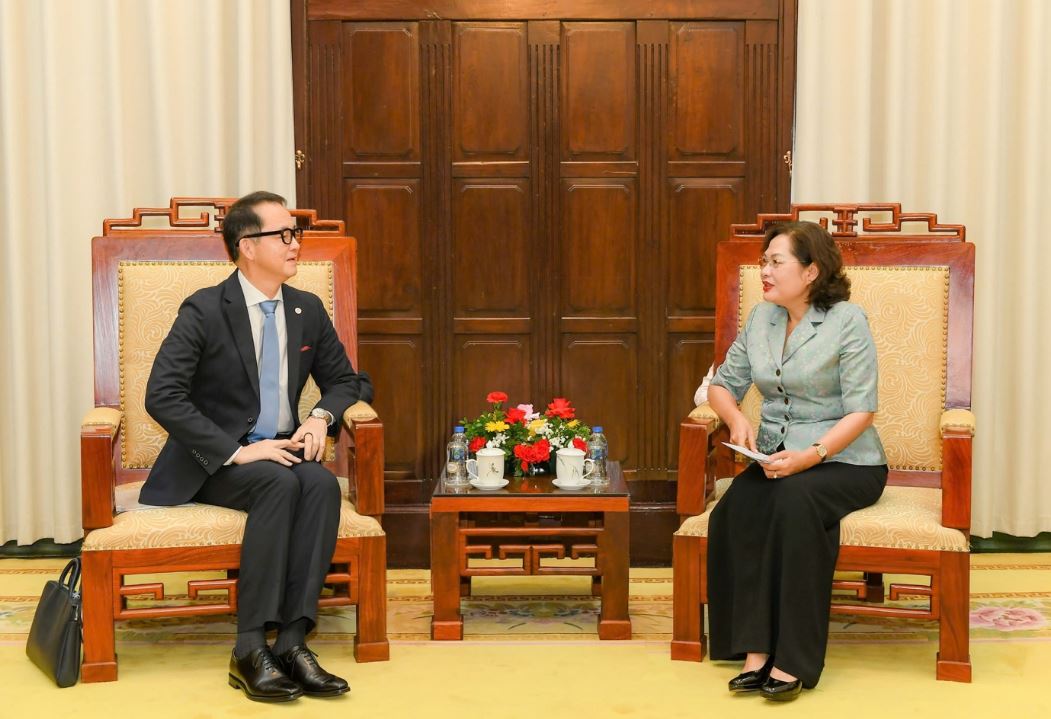
Governor Nguyen Thi Hong and AMRO Director Yasuto Watanabe at the meeting
At the meeting, Governor Nguyen Thi Hong welcomed Mr. Yasuto Watanabe on his first official visit to Vietnam in his capacity as AMRO Director.
The Governor highly appreciated the close and effective cooperation between AMRO and Vietnamese ministries and agencies, particularly the SBV. This collaboration has been reflected through regular mid-year and annual consultations, as well as capacity-building initiatives such as staff secondment programs and sponsorship for SBV officials to participate in training courses, conferences, and seminars on central banking-related topics.
For his part, Mr. Yasuto Watanabe expressed his sincere appreciation to the SBV for its strong support and close coordination with AMRO in recent years within the ASEAN+3 financial and monetary cooperation framework, especially in regional macroeconomic surveillance and the implementation of the Chiang Mai Initiative Multilateralisation (CMIM).
Sharing his views at the meeting, Mr. Dong He, AMRO Chief Economist, noted that the ASEAN+3 region is currently facing risks and challenges arising from the U.S. tariff policies and ongoing conflicts in the Middle East, which have contributed to the volatilities in global energy prices. Nevertheless, the ASEAN+3 region has demonstrated strong resilience, with growth exceeding expectations and inflation remaining stable. Vietnam was highlighted as a bright spot, recording the highest growth rate in the region in 2025. In this context, AMRO recommended that Vietnam gradually shift its monetary and fiscal policies from an accommodative to a more neutral stance to create more additional policy space for responding to potential future shocks.
Governor Nguyen Thi Hong acknowledged AMRO’s recommendations and noted that the SBV had proactively identified risks related to credit growth and implemented appropriate measures to address them. She emphasized that the SBV will continue to closely monitor oil price movements, particularly amid increasingly complex developments in the Middle East, and will manage monetary policy proactively to control inflation and support macroeconomic stability.
Regarding the green energy transition, the Governor stated that Vietnam is pursuing sustainable economic development driven by digital transformation and the promotion of green energy, especially in light of the country’s target of achieving double-digit economic growth during the 2026–2030 period. Vietnamese ministries and agencies, including the SBV, are also developing AI-based databases and leveraging the potential of artificial intelligence (AI). In this regard, the Governor expressed her appreciation for AMRO’s research on the application of AI in banking supervision across ASEAN+3 countries, and her desire to further strengthen cooperation with AMRO in information sharing and AI applications.
In conclusion, both the SBV Governor and the AMRO Director expressed their expectation that cooperation between the SBV and AMRO will continue to deepen and become more effective in the coming period, not only in policy dialogue but also in technical assistance and capacity building for SBV staff in monetary policy formulation and implementation, as well as in banking system management.