
On 26 - 27 November 2025, a delegation of the State Bank of Vietnam (SBV), led by Deputy Governor Doan Thai Son, attended the ASEAN+3 Finance and Central Bank Deputies’ Meeting (AFCDM+3) held in Hong Kong, China.
The meeting gathered senior leaders from central banks, monetary authorities, and finance ministries of the ASEAN+3 member economies, together with representatives from several international organizations, including the International Monetary Fund (IMF), the Asian Development Bank (ADB), and the ASEAN+3 Macroeconomic Research Office (AMRO).
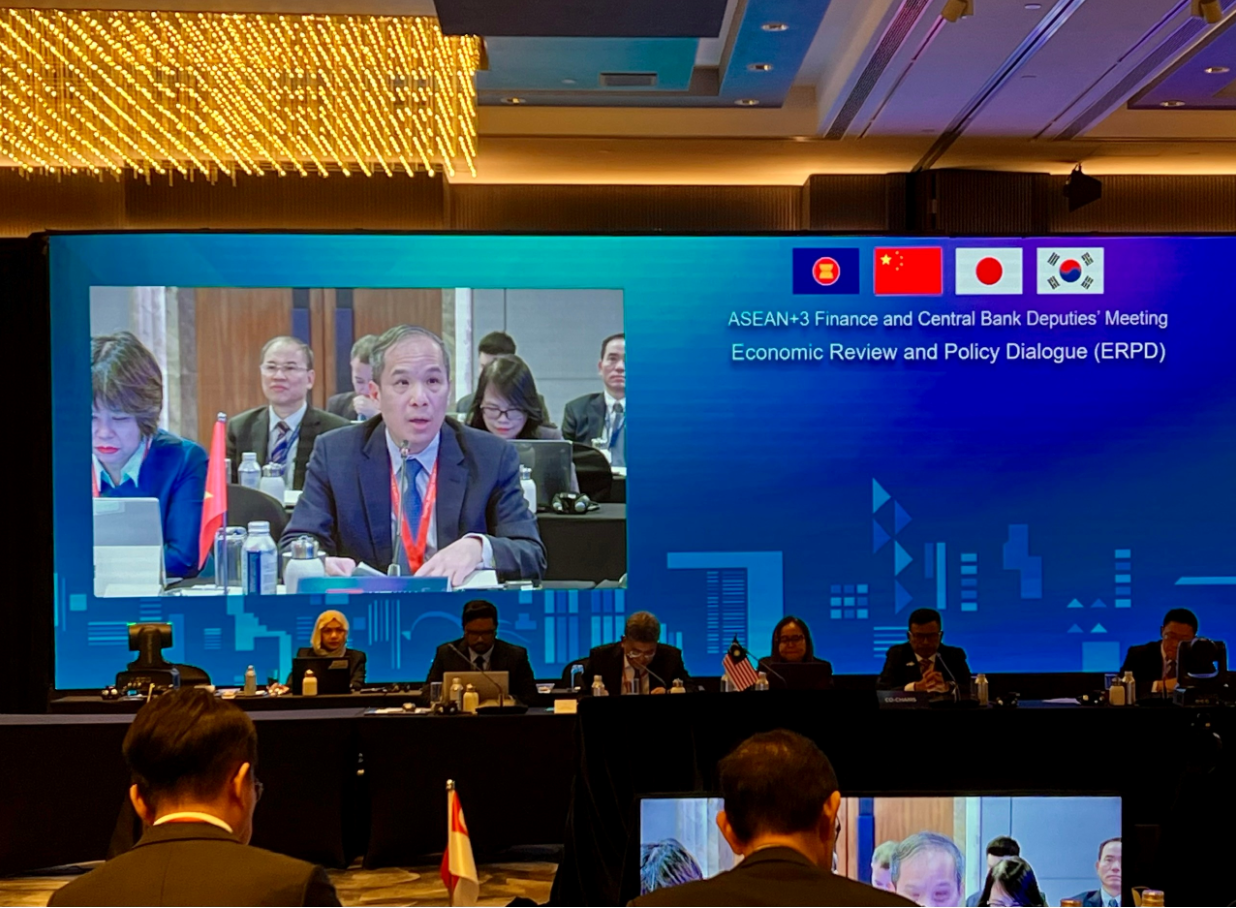
SBV Deputy Governor Doan Thai Son at the meeting
AFCDM+3 is an annual high-level meeting within the ASEAN+3 finance and banking cooperation framework. At the meeting, ASEAN+3 Deputy Governors and Vice Ministers reviewed the global and regional economic outlooks and endorsed strategic directions and key deliverables across the ASEAN+3 financial cooperation agenda, including matters related to the Chiang Mai Initiative Multilateralisation (CMIM), AMRO operations, and ongoing ASEAN+3 cooperation initiatives.
Global and Regional Macroeconomic Developments
At the meeting, the IMF noted that the global economies had performed better than expected. Tariff levels were stabilizing, although policy uncertainties remained elevated. According to the IMF, international financial conditions had eased considerably since early April 2025 thanks to higher corporate valuations and reduced market volatilities, even as advanced economies continued to face fiscal risks.
The IMF projected ASEAN+3 growth at 4.3% in 2025 and 4.1% in 2026, slightly higher than the earlier forecasts. Nonetheless, medium-term prospects remained subdued due to lower potential growth driven by weak productivity, adverse demographics, and slowing investment. Key risks included:
prolonged trade tensions and rising protectionism;
mispricing of new technologies;
labour shortages;
fiscal vulnerabilities and financial fragility;
weakening governance and institutional independence;
and the possibility of renewed increases in global commodity prices.
In this context, the IMF recommended that macroeconomic policy focus on shock absorption, reducing uncertainty, advancing structural reforms, and deepening regional integration in trade and finance.
AMRO similarly highlighted that U.S. tariff increases would affect the region through channels such as weaker U.S. demand, trade disruptions, and supply-chain adjustments, thereby exerting downward pressure on short-term growth. Nevertheless, AMRO revised upward its 2025 ASEAN+3 growth forecast due to lower-than-expected effective tariffs, robust technology-related exports, rising investment flows into ASEAN, and continued monetary and fiscal support. Inflation had evolved in line with expectations. Growth was expected to moderate in 2026 amid weaker external demand, though inflation would remain low and stable.
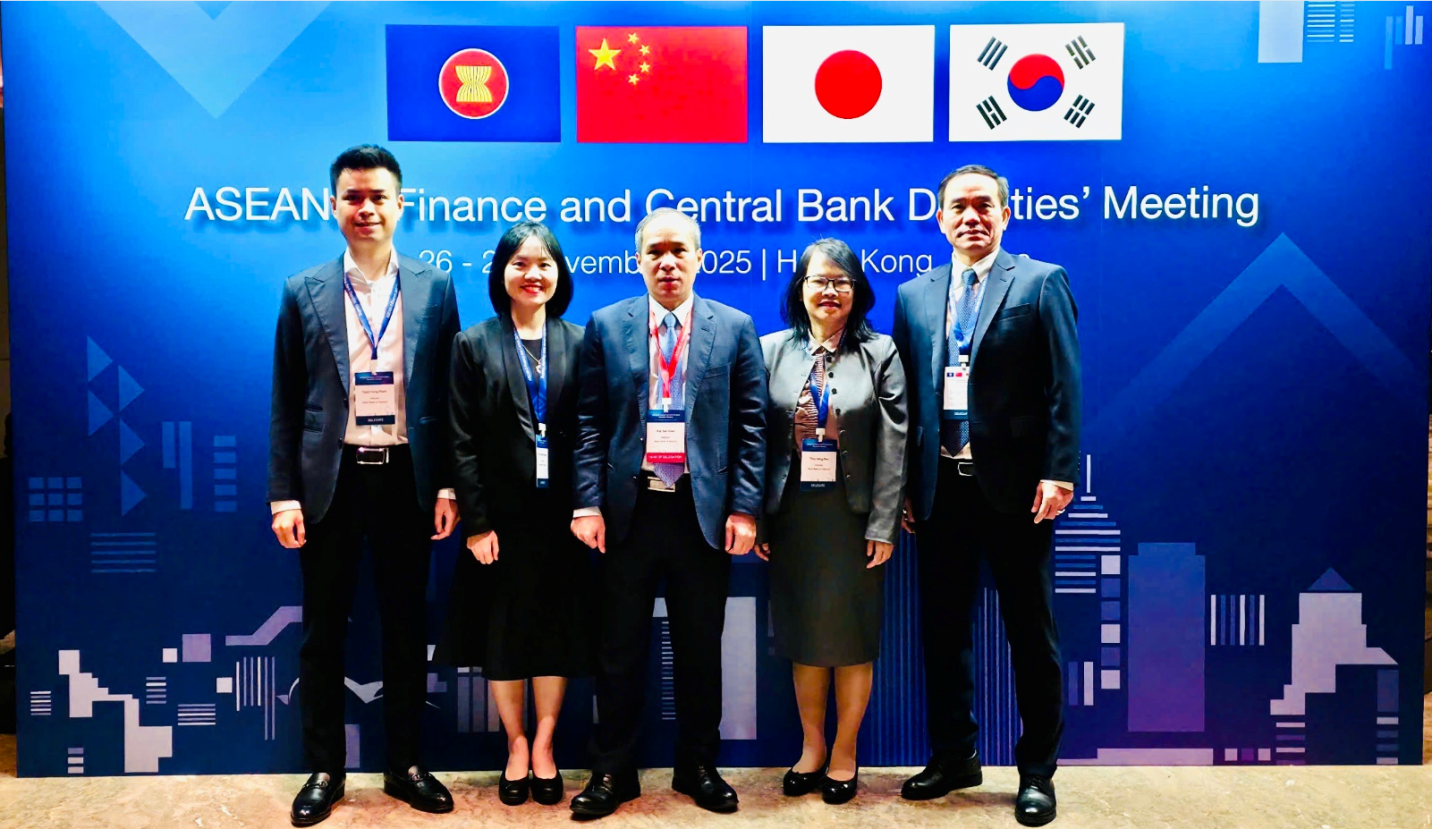
Delegates attending the meeting take a commemorative photo
AMRO emphasized that although regional risk balances had improved since early 2025, policy uncertainties - particularly from the U.S. - continued to weigh on the regional outlook. AMRO recommended stronger regional integration to reinforce long-term resilience, noting that intra-ASEAN trade and investment links remained uneven despite reduced dependence on external demand. ASEAN economies’ efforts to attract investment and upgrade regional value chains were seen as critical to strengthening the broader ASEAN+3 region.
According to the ADB, Asia–Pacific financial conditions remained generally robust but were highly sensitive to shifts in market expectations regarding U.S. Federal Reserve policy. Prolonged uncertainties over Fed’s policy direction could tighten regional financial conditions, increase capital-flow volatilities, and heighten exposure to global risks. While capital flows to emerging markets remained vulnerable to global shocks, strong domestic fundamentals - sound policy frameworks, developed financial markets, and stable macroeconomic indicators - had helped mitigate volatilities.
The ADB underscored the importance of safeguarding the central banks’ independence, maintaining fiscal discipline amid rising public debts, deepening regional integration, developing domestic financial markets, and strengthening institutional capacity to enhance resilience against external shocks.
The ASEAN+3 finance and central bank deputies agreed that sustaining stability and long-term growth required stronger regional cooperation, structural reforms, and flexible yet stable financial policies. They highlighted several priority areas, such as financial cooperation, e-commerce, digital technology, and environmental cooperation. Strengthening financial stability remained a top short-term priority, supported by measures to bolster foreign-exchange reserves and maintain flexible monetary operations.
The delegates also emphasized the need to deepen investment connectivity and promote intra-regional trade. ASEAN+3 reaffirmed its commitments to sustainable investment, enhanced payment-connectivity initiatives, and cross-border financial cooperation. China shared its strategy of boosting domestic consumption and further opening markets - particularly in digital and green sectors - to create new regional opportunities. Thailand and the Philippines reported measures to reduce public debt and promote investment in technology and renewable energy to secure long-term economic resilience.
Deputy Governor Doan Thai Son’s Remarks
Addressing the meeting, Deputy Governor Doan Thai Son concurred with the assessments of the international organizations, noting that despite the region’s resilience to trade-related challenges, ASEAN+3 economies must continue strengthening policy clarity, adaptive capacity, and regional cooperation to maintain stability. He emphasized that structural reforms were essential to unlocking new growth opportunities and deepening regional integration in trade and finance. Central banks, he remarked, play a pivotal role in maintaining macroeconomic and financial stability and safeguarding market confidence.
Vietnam’s Macroeconomic Outlook
Deputy Governor Doan Thai Son shared that Vietnam’s macroeconomic developments were aligned with the positive trends highlighted by the international institutions. Vietnam’s growth in 2024 - 2025 remained robust, supported by the domestic consumption, manufacturing exports, and strong FDI inflows - especially in electronics and green industries. The inflation was well-controlled and overall financial conditions remained stable.
He acknowledged the challenges identified by AMRO, including weaker external demand and an uncertain outlook for export-oriented SMEs. Vietnam’s current priorities include:
strengthening policy buffers;
enhancing banking-sector resilience;
accelerating digital-payment reforms;
developing capital markets;
and improving transparency in the foreign-exchange market.
He reaffirmed Vietnam’s strong commitment to deeper regional financial integration and support for ASEAN+3 initiatives on financial liberalization, harmonization of standards, and cross-border financial cooperation. Vietnam would continue working closely with ASEAN+3 partners and institutions such as the IMF, the ADB, and AMRO to maintain regional stability, strengthen policy coordination, and reinforce the long-term resilience of the regional financial architecture.
Progress of ASEAN+3 Financial and Banking Cooperation
The meeting reviewed and endorsed several key documents guiding ASEAN+3 financial cooperation in the coming years, including:
the Updated 2019 Strategic Direction;
AMRO’s 2026–2028 Medium-Term Plan;
the 2025 Macroeconomic Surveillance Guidance for ASEAN+3 economies;
AMRO’s 2026 budget and staffing plan;
and the AMRO Director Performance Evaluation Framework.
The delegates also discussed initiatives to enhance CMIM’s operational readiness to support the member economies facing liquidity or balance-of-payments pressures. The meeting approved the establishment of a three-year review cycle for the USD interest-rate spread, beginning in 2027, to align with international best practices and ensure CMIM’s continued relevance and sound governance. Delegates also endorsed the periodic review plan for the IMF-delinked portion (IDLP) and noted the results of the 16th CMIM Test Run.
A key agenda item was the proposal to develop a new financial structure for CMIM by transitioning to a Paid-in Capital (PIC) model. This initiative - endorsed at the ASEAN+3 Finance Ministers’ and Central Bank Governors’ Meeting (AFMGM+3) in May 2024 -aims to strengthen the region’s financial safety net to better prevent, mitigate, and respond to future crises. On this matter, Deputy Governor Doan Thai Son emphasized that PIC represents a major structural shift, requiring a gradual and prudent, phased approach accompanied by comprehensive legal, governance, financial, and capacity assessments.
The meeting also talked about the expansion of the ASEAN+3 cooperation on priority areas including infrastructure financing, digitalization in banking and payments, progress under the Asian Bond Markets Initiative (ABMI) with a focus on sustainable bond markets and energy-transition finance and updates on the development of the ASEAN+3 Disaster Risk Financing Roadmap 2026 - 2028.
The meeting agreed to transfer the ASEAN+3 Finance Process co-chairmanship for 2026 to Japan and the Philippines.
HA