
On May 7, 2026, at the headquarters of the State Bank of Vietnam (SBV), Governor Pham Duc An held a meeting with Mr. Jochen Schmittmann, IMF Regional Resident Representative for Vietnam, Lao PDR and Cambodia.
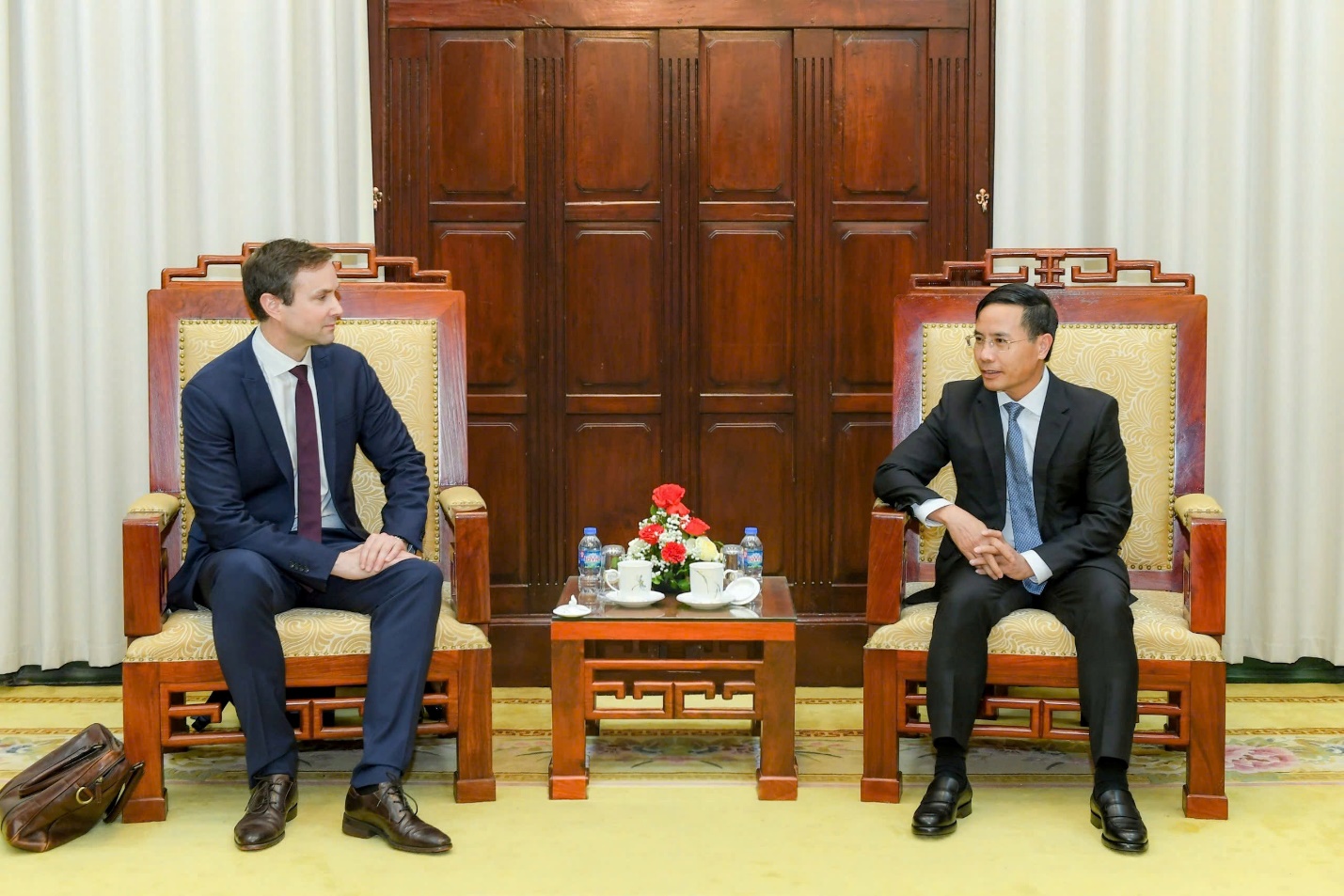
Governor Pham Duc An and Mr. Jochen Schmittmann, IMF Regional Resident Representative for Vietnam, Lao PDR and Cambodia, at the meeting
At the meeting, Mr. Jochen Schmittmann highly praised Vietnam’s socio-economic development achievements in recent years, particularly its positive growth performance, inflation control, and maintenance of macroeconomic stability amid uncertainties in the global economy. The IMF Regional Resident Representative noted that Vietnam remains a bright spot in the region, with favorable growth prospects supported by effective coordination between fiscal and monetary policies.
In addition, Mr. Schmittmann pointed out that Vietnam’s economy still faces certain risks arising from the international environment, including geopolitical tensions, trade fluctuations, and volatilities in commodity prices, especially energy and food prices. On that basis, the IMF recommended that Vietnam pay close attention to both the direct and spillover impacts of these factors on monetary policy management, while continuing to modernize and enhance the policy framework in a more flexible manner, in line with international practices.
In his remarks, Governor Pham Duc An expressed his appreciation for Mr. Schmittmann’s constructive assessments and recommendations. He shared that Vietnam is striving to become a high-income country by 2045, with strong determination to renew its growth model by taking science and technology, innovation, and the private sector as key drivers of development.
The Governor emphasized that, in recent years, the SBV has conducted monetary policy in a proactive and flexible manner, maintaining inflation within the target range, thereby contributing to macroeconomic stability and supporting sustainable economic growth. However, inflationary pressures in 2026 may increase; therefore, monetary policy management should continue to be implemented prudently and closely aligned with actual developments, while consistently pursuing the objectives of inflation control and macroeconomic stability.
Regarding the IMF’s recommendations on credit scale and the economy’s dependence on the banking credit channel, the Governor stated that the SBV acknowledges and shares the view that the financial system should gradually develop in a more balanced manner. Accordingly, alongside credit management in line with macroeconomic stability objectives and system safety, Vietnam will continue promoting the development of the capital market and improving the legal framework for the corporate bond market in a transparent, disciplined, safe, and sustainable direction. These efforts aim to strengthen investor confidence, diversify medium- and long-term funding channels for the economy, and gradually reduce excessive dependence on bank credit.
The Governor also affirmed that the banking system will continue to play an important role in providing capital and financial services to the economy. However, banking operations must be based on strong risk governance, sound credit quality, and an appropriate credit structure.
Regarding data and statistics, the Governor acknowledged the IMF’s views on the need to further improve the quality, completeness, and timeliness of data serving supervision, analysis, and policy formulation. The SBV will continue enhancing the quality of statistical work and strengthening coordination with relevant ministries and agencies to gradually improve the data system and methodologies in line with international standards, thereby better meeting the requirements for analysis, policy management, and information provision obligations within the framework of cooperation with the IMF.
Regarding future cooperation, the Governor expressed his hope that the IMF and its Representative Office in Vietnam would continue to maintain regular and substantive policy dialogue in a constructive spirit, while strengthening technical assistance and capacity building for the SBV in priority areas such as monetary policy management, statistics, financial stability, and banking supervision.